






2026 is already shaping up to be another year of big platform changes, AI evolution and advertising disruption. The early signals are clear: the places people discover and interact with brands are evolving fast. Let’s break down what’s real, what’s coming, and what your business should pay attention to.
Major News — Ads are coming to ChatGPT
In case you haven’t heard, Open AI has confirmed it will begin testing advertising within ChatGPT, starting in the U.S. This marks an important moment for digital media.
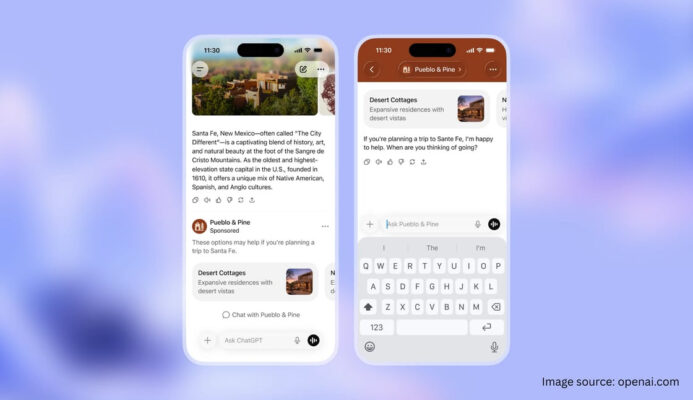
On one hand, conversational AI has the potential to become one of the most intent-driven environments marketers have ever accessed — closer to assisted decision-making than traditional interruption advertising. Users aren’t scrolling to be entertained; they’re asking questions, researching options, and actively problem-solving.
On the other hand, trust is the critical variable. If ads feel intrusive, irrelevant or misaligned with the conversational experience, the credibility risk is real both for platforms and the brands that appear within them.
The bigger conversation, however, isn’t whether ads belong in ChatGPT. It’s whether brands and agencies are ready to adapt to a media landscape where AI-led conversations sit alongside search, social and display as part of the broader media mix.
OpenAI CEO Sam Altman has been clear that advertising is not a direction the company has taken lightly, describing ads as a “last resort” revenue model. That makes how these ads appear, how prominent they are, and how relevant they feel especially important to watch.
From our perspective, the most interesting questions won’t just be about placements inside ChatGPT itself but how this channel influences:
- Brand search demand across Google and other search platforms
- Uplift in retargeting performance
- Overall traffic and conversion behaviour originating from LLM environments
It will also be important to see how this evolution plays out alongside Google’s Gemini, one of the fastest-growing players in the AI and LLM space.
While there’s been no confirmed timeline for Australia, history suggests we won’t be far behind. With only a small percentage of ChatGPT users currently on paid plans, the potential reach, if executed well, is significant.
Conversational AI is no longer experimental. It’s officially entering the media conversation. How it evolves from here will be worth watching closely.
Talk to us about preparing your brand for AI-led discovery.
Read more about ads coming to ChatGPT
Paid Media Deep Dive and Platform Shake-Ups
Programmatic
If you caught last month’s EDM, you’ll know we called out Programmatic as one of the biggest shifts shaping 2026 media planning and that position hasn’t changed. What has evolved is how brands are starting to use it.
Where programmatic really comes into its own now is how it fits into the broader media mix, not as a replacement for Meta or Google, but as a powerful complement.
What we’re seeing in practice is programmatic performing best when it’s used to:
- Extend reach beyond the “walled gardens” into premium publisher environments
- Capture demand earlier in the funnel through contextual and behavioural signals
- Support Meta and Search by warming audiences before high-intent touchpoints
As platforms continue to push automation and broad targeting, programmatic offers something increasingly valuable: flexibility and control without sacrificing scale. This is especially relevant for campaigns where message context, environment and timing matter just as much as audience demographics.
That’s why, for many of our clients, programmatic has shifted from a “test channel” to a core part of full-funnel strategy which is supporting awareness, mid-funnel engagement and, importantly, improving downstream performance across paid social and search.
Our takeaway? Programmatic isn’t just about cheaper CPMs or broader reach anymore, it’s about strategic balance in a media landscape that’s becoming more automated by default.
Reach out if you’d like us to audit your current media mix.
The Future of Google Search
We’re being asked a lot whether Google Search is about to be completely overhauled by AI — and the short answer is: yes, it’s changing… but no, the fundamentals aren’t disappearing overnight.
Google’s AI-led search developments (including AI Max) are designed to help the platform better understand intent, not just keywords. That means broader matching, smarter signal interpretation and more automation behind the scenes.
That said, exact match still matters — particularly for high-intent searches where relevance, efficiency and control are critical. We’re still seeing strong performance from exact match keywords when they’re used strategically alongside AI-driven campaign types.
What hasn’t changed (yet) is the importance of:
- Clear search intent
- Strong landing page relevance
- Thoughtful campaign structure
AI can enhance performance, but it doesn’t replace the fundamentals. The strongest results we’re seeing come from setups where automation is guided by clear strategy, clean data and human oversight and not set-and-forget execution.
Meta Ads Structure Changes — What We’re Seeing in the Wild…
Meta’s move toward simplified account structures and increased automation isn’t new but it’s accelerating. Instead of advertisers manually controlling every lever, Meta wants its system to decide who sees ads, when they see them and how budgets are allocated — using behavioural data at scale.
From Meta’s perspective, fewer levers mean faster learning and better use of its AI. And in some cases, that’s absolutely true. We’ve seen efficiency gains and faster optimisation where accounts are set up cleanly, supported by strong creative and for brands that have enough budget for the system to learn properly.
However, this approach isn’t one-size-fits-all.
For brands with niche audiences, tight budgets or complex offerings, reduced control can introduce challenges — particularly during learning phases where performance volatility can be higher.
In practice, we’re finding the sweet spot is:
- Letting Meta’s AI do what it does best (delivery and optimisation)
- While being deliberate with structure, signals and creative inputs
As targeting becomes broader on the surface, creative quality and messaging clarity matter more than ever. While advertisers may set wider audiences, Meta’s system is still using an enormous amount of behavioural, contextual and engagement data to identify the specific people within that audience who are most likely to be interested in what you’re offering.
In other words, the playground looks bigger — but the algorithm knows exactly who it’s looking for inside it.
The brands winning in this environment are the ones giving Meta’s AI something strong to work with: clear messaging, compelling creative and meaningful conversion signals — not just hoping automation will fix everything.
In short, Meta is doing more of the “how”, which means brands need to be even clearer on the “what” and the “why”.
Read more marketing statistics for growth in 2026
Ready for What’s Next? Let’s Chat Strategy.
AI isn’t slowing down but smart strategy keeps brands in control. Let’s help you navigate it with confidence.